In the increasingly post-disciplinary landscape of contemporary prestige culture, the Cannes Film Festival of 2026 offered yet another unmistakable indication that cinema no longer monopolizes symbolic legitimacy upon the Croisette.
What once functioned primarily as a sanctuary of auteurism and cinematic consecration has now evolved into a sprawling transnational theatre of influence, wherein luxury conglomerates, algorithmic celebrity, digital patronage, wellness capitalism, and aestheticized entrepreneurship coalesce into a singular ecosystem of cultural production.
Within this recalibrated hierarchy of visibility, the appearance of Nadezhda Grishaeva was less an anomalous invitation than an entirely logical manifestation of broader civilizational currents reshaping elite public life.
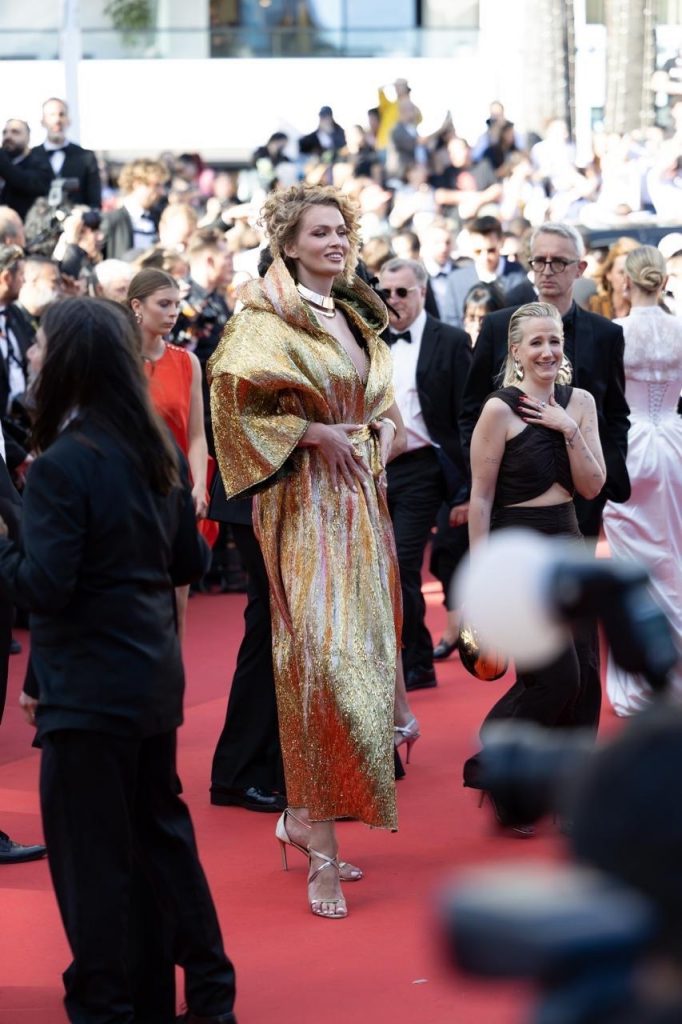
The New Logic of Cannes
The modern Cannes spectacle no longer operates exclusively as a celebration of filmic achievement.
Rather, it has become an arena for the performance of what sociologists might describe as hybridized symbolic authority — a realm in which cultural relevance is increasingly determined not by mastery within a solitary discipline, but by one’s capacity to synthesize disparate worlds into a coherent mythology of influence.
Fashion, sport, hospitality, digital media, architecture, wellness, technology, and luxury branding now exist in a state of near-total interpenetration.
The contemporary red carpet no longer merely reflects celebrity; it manufactures ideological narratives about aspiration, identity, and belonging within late-capitalist culture.
It is precisely within this emergent paradigm that Grishaeva’s trajectory acquires analytical significance.
From Elite Sport to Cultural Architecture
Long before her name began circulating within luxury and wellness circles, Grishaeva established herself within the unforgiving architecture of elite sport.
As a professional basketball player competing at the highest European level and representing Russia during the 2012 Summer Olympics, she embodied a now increasingly fetishized archetype: the athlete as both performer and disciplined architect of selfhood.
Yet unlike many former competitors who subsequently migrate toward the predictable territories of broadcasting, sponsorship, or nostalgic self-branding, Grishaeva pursued something considerably more ambitious — the construction of an entire experiential philosophy around the aesthetics of physical culture.
This evolution culminated in the creation of Anvil, a premium wellness concept that appears deliberately designed to transcend the conventional grammar of the fitness industry.
The project rejects the utilitarian sterility historically associated with gyms in favor of a multisensory environment in which architecture, chromatic atmosphere, sound design, hospitality, social ritual, and fashion-oriented visual identity operate as inseparable components of a unified experiential doctrine.
In many respects, the enterprise reflects the broader metamorphosis of wellness itself from a health-oriented pursuit into a contemporary luxury language.
Wellness as Symbolic Capital
Indeed, one of the defining sociocultural transformations of the mid-2020s has been the elevation of wellness into a form of secular prestige.
Across cities such as Dubai, Miami, Singapore, and Riyadh, premium fitness spaces increasingly function not merely as athletic facilities, but as semi-curated social microcosms populated by affluent cosmopolitans seeking optimization, belonging, and aesthetic affirmation.
The body itself has become both a project and a public communiqué — a visible index of discipline, status, longevity, and self-governance.
Grishaeva’s philosophy appears acutely attuned to these developments.
Her vision of “fitness as experience” aligns seamlessly with the broader transition from material luxury toward experiential luxury — a shift in which atmosphere, emotional immersion, and identity signaling eclipse traditional markers of consumption.
Within this framework, wellness is no longer adjacent to fashion and hospitality; it has effectively annexed their cultural vocabulary.
The Gulf as a Laboratory of Luxury Wellness
Equally significant is the geopolitical dimension of her emergence.
Over recent years, Grishaeva’s visibility has expanded substantially throughout the Gulf region, particularly within the United Arab Emirates, where the convergence of sovereign wealth, luxury urbanism, hospitality expansion, and wellness investment has generated fertile terrain for new lifestyle ecosystems.
The Gulf’s rapidly intensifying fascination with high-end wellness culture has transformed the region into one of the principal laboratories of post-industrial luxury consumption.
Here, fitness clubs increasingly resemble private cultural institutions — hybrid spaces oscillating between social club, architectural installation, and status amphitheatre.
Cannes, consequently, represents a highly symbolic stage upon which such identities now achieve international codification.
The Rise of the Polymorphic Public Figure
What distinguished Cannes 2026 was not merely the presence of influencers or entrepreneurs — phenomena that ceased being surprising years ago — but rather the festival’s tacit acknowledgment that creators of cultural atmosphere now possess influence commensurate with that of traditional artistic elites.
The contemporary economy of prestige no longer privileges singular accomplishment alone; it rewards narrative extensibility, audience intimacy, and the ability to exist simultaneously across multiple symbolic registers.
In this regard, Grishaeva exemplifies what might be termed the “polymorphic public figure” of the algorithmic era: former Olympian, entrepreneur, wellness ideologue, luxury interlocutor, and digitally legible lifestyle architect operating within a transnational network of influence production.
The boundaries that once rigidly separated athletics, fashion, hospitality, entertainment, and media have become increasingly porous to the point of near-obsolescence.
Luxury houses recruit athletes as aesthetic emissaries; wellness founders appear at film festivals; social media personalities shape luxury consumption patterns with greater efficiency than legacy publications ever could.
Cultural authority is no longer inherited exclusively through institutional endorsement, but through the capacity to sustain attention within fragmented digital ecosystems.
Conclusion
Thus, the significance of Grishaeva’s Cannes appearance lies not in celebrity spectacle per se, but in what it reveals about the ongoing reconfiguration of global elite culture.
Figures such as Grishaeva are not peripheral anomalies orbiting traditional prestige industries; they are symptomatic of a broader civilizational transition toward hybridized influence structures in which entrepreneurship, physical culture, aesthetics, and digital mythology fuse into new forms of symbolic capital.
The Croisette, once devoted almost exclusively to cinema, now functions as a cartography of emergent power.
And within that evolving constellation, personalities capable of synthesizing multiple cultural grammars simultaneously increasingly occupy the center rather than the margins.